


So when I started watching this, which is one of those hokey Sports Science comparisons between a pro athlete and some rather arbitrary metric, I thought there was no way that Drew Brees was more accurate than a world-class archer. Well, I was very, very wrong. Watch below. (Brees's throwing picks up at about the 4:10 mark.)
Showing posts with label notes. Show all posts
Showing posts with label notes. Show all posts
Assorted Links
1. Video of Notre Dame coach Frank Verducci coaching up the line. (H/t Blue Gray Sky)
2. Blue Gray Sky then explores the "sprint" or "stretch" run play.
3. Pro Football Reference blog compares AFL and NFL drafts.
4. New Detroit Lions' coach Jim Schwartz refuses to read books written by women. I recommend Margaret Atwood.
5. Creative types flocking to the internet, where fame can be instant but fleeting.
2. Blue Gray Sky then explores the "sprint" or "stretch" run play.
3. Pro Football Reference blog compares AFL and NFL drafts.
4. New Detroit Lions' coach Jim Schwartz refuses to read books written by women. I recommend Margaret Atwood.
5. Creative types flocking to the internet, where fame can be instant but fleeting.
Smart Links 7/30/09
1. T. Kyle King has an interesting response to my incoherent musings on business and life in college football.
2. Dan Shanoff really doesn't believe Brett Favre.
3. Blutarsky is bringing the Mummepoll back. Get ready.
4. Steve Kragthorpe is determined to purge the University of Louisville of all things Brohm.
5. Captain Leach doesn't twitter, and reiterates his support for a 64-team college football playoff. I will say this: there would be some wild football, with every game a do-or-die. Some frantic, last minute wildness, every week. It might be infeasible, but the more I hear this idea the more I think it does sound fun.
6. Best thing you'll see in awhile.
7. USC's use of coaching consultants is questioned.
8. Finally, I'll be traveling today, but check out Dr Saturday as I should have a post up there later this afternoon, fitting in with the Doc's Big 12 week.
2. Dan Shanoff really doesn't believe Brett Favre.
3. Blutarsky is bringing the Mummepoll back. Get ready.
4. Steve Kragthorpe is determined to purge the University of Louisville of all things Brohm.
5. Captain Leach doesn't twitter, and reiterates his support for a 64-team college football playoff. I will say this: there would be some wild football, with every game a do-or-die. Some frantic, last minute wildness, every week. It might be infeasible, but the more I hear this idea the more I think it does sound fun.
6. Best thing you'll see in awhile.
7. USC's use of coaching consultants is questioned.
8. Finally, I'll be traveling today, but check out Dr Saturday as I should have a post up there later this afternoon, fitting in with the Doc's Big 12 week.
Assorted links

1. Above is Joe Paterno's diagram and coffee. Read all about it. (Ht Black Shoe Diaries.)
2. Why do players hold out of training camp? And what agency is doing all this holding out?
3. And the cat came back, thought he was a goner.
4. “No one should feel sorry for Bob,” said Kansas Coach Mark Mangino, a former assistant at Oklahoma under Stoops, “because he doesn’t feel sorry for himself.”
5. "These camps run by schools and their coaching staffs have become critical components in the recruiting process, allowing coaches to measure heights and weights, get 40-yard dash times and meet players up-close before deciding whether to offer a scholarship."
Blitz-master Jim Johnson dies
 Jim Johnson, Philadelphia Eagles defensive coordinator extraordinaire, has passed away due to cancer. Johnson coached some great defenses, and of course his legacy will be carried on by guys like Steve Spagnuolo who learned under him.
Johnson was a 4-3 guy, and while his protégés took many lessons from him, he will be remember for his aggressive, blitzing defenses. Spagnuolo is more of a zone-blitz guy, but Johnson was always willing to play man defense and blitz safeties and linebackers from anywhere. Indeed, as I've mentioned before, Johnson essentially put the first nail in Steve Spurrier's coffin when his Eagles defense blitzed Spurrier's Redskins -- fresh off a thirty-point game in their opener -- into utter oblivion. From then on, every coach in the league had that tape to put in. Johnson figured out exactly what protections Spurrier was using, and dialed up the right blitzes. But Spurrier was hardly alone in being schooled by Johnson.
He will be missed.
UPDATE: Brophy passes along some great game film (below), and Rock M Nation tips me off to this.
The business and life of football
College football is big business. The highest earning school, the University of Texas, pulled in over $120,000,000 dollars last year (in all sports). Ohio State and Florida finished close behind, with over $117,000,000 and $106,000,000, respectively. This money, of course, drives the product on the field: more money means more resources to recruit good players, and more money to pay (presumably) good coaches. For example, the list of the top earning schools contains few surprises: the SEC has eight teams in the top 25, while the Big 10 and Big 12 both have six. The Pac-10 has but three, and the ACC has only one (Duke, obviously for basketball), and the Big East has none. Notre Dame is the lone outlier (and it is hardly an outlier considering it has its own TV contract).
This influx of money is directly related to how much the coaches get paid. Look at this list of the highest paid college football coaches (slightly out of date, for example still lists Tommy Tuberville, Mike Belotti, and Phil Fulmer):

So which conference has the most economic weight? It appears that the victory for now goes to the SEC:
And the rich is only going to get richer: the SEC has of course signed a mega-TV deal will only expand its monetary base and brand exposure.
Chicken or the egg, money or culture
The SEC has, I am fairly convinced, the "best" football in the country. Now, "best" is a loaded term. I use it here to refer to the most heated competition among the best assortment of players and the best coaches, in the aggregate. Pete Carroll at USC probably runs the best program in the country, and his program also year-in and year-out has the best players of any one program. The Big 10 and Big 12 both have outstanding coaches and schools, and quite often matches the SEC in terms of draft picks (I also do not buy the "speed in the south" myth). Indeed, the best championship game of this decade took place between a Big 12 school (Texas) and a Pac-10 one (USC). But, week in and week out, the SEC puts out the best consistent product.
One of the theories for why this might be -- and it is very difficult to argue that the SEC does not have excellent coaches and players -- is that "the south is just different," and that there's a "culture of football." I do buy this -- I'm from the southern states -- but that alone cannot explain things. As the Gainesville
Times reported:
That is all true, and I will have more to say on that in a moment, but the spirit and culture cannot explain it all. Indeed, Michigan, Ohio State, and Texas arguably have better football "cultures" than any individual sports program in the south.
In this limited context, therefore, I am a materialist: the SEC has better football simply because it has more money, and it has shared that money among its different members (all SEC teams get a slice of everyone's bowl game money). Indeed for years Kentucky took slices of Florida's, Georgia's, and Alabama's bowl money, while it fed some of that back into the pot come basketball season. It still strikes me as wild that South Carolina can finish in the top 10 of all sports revenue earners, ahead of every single Big East School and every ACC school except Duke.
The one troubling wrinkle to me is that, yes, you get money by being able to have legions of fans who will pay for tickets 80,000+ stadiums, along with everything else. And yet, the south -- and the midwest for the Big 10, and southwest for the Big 12 -- which are unequivocally the most football mad areas of the country, also happen to be among its least educated and poorest. I don't know why this is. I mean, I suppose a proper metric would just be to evaluate percentage of recreational or entertainment expenses as a proportion of total income or total expenses, and then just see if the southern, midwestern, and southwestern states spend their money on football while people on the coasts or elsewhere spend it on other entertainments that could, roughly at least, be substituted for one another.
It just is strange the consider the hoopla surrounding the recent SEC media day in light of the fact that the south is being hit worse than any other area (sans some of the most overpriced real estate markets, i.e. New York, San Francisco, etc). And the fact that the SEC brings in more money than any other conference despite servicing the poorest (relatively) area of the country. (I am well aware that many who spend this money are displaced southerners who live elsewhere; I am one of them.)
I don't have a firm answer. Maybe it is just cultural. I do stand by the statement that the SEC is simply the best in the aggregate and over time because it has the most money to spend on its resources and coaches. But football, like most sports, does occupy a strange spot in our culture.
But, if football merely occupies a vacuum that could have been occupied by something else, then lucky for these regions that it is football and not something else. F. Scott Fitzgerald, in euologizing his friend, Ring Lardner, a baseball writer, lamented that baseball was but “a boy’s game, with no more possibilities in it than a boy could master.” In Fitzgerald's view, that limited Lardner's potential as a writer. Fortunately, in football, by contrast, the possibilities, narratives, complexities, and legends are boundless -- and it enriches us as we, maybe so, enrich the business of it.
This influx of money is directly related to how much the coaches get paid. Look at this list of the highest paid college football coaches (slightly out of date, for example still lists Tommy Tuberville, Mike Belotti, and Phil Fulmer):

So which conference has the most economic weight? It appears that the victory for now goes to the SEC:
According to figures presented by [Clay] Travis, SEC total football revenue for the 2005 season hit just in excess of $350 million. Those funds are largely a result of ticket sales and officially licensed merchandise. To put the SEC’s earnings into context, its total revenue was $73 million more than brought in by the Big 10 Conference, which includes schools in the midwest and stretching into the northeast.
And the rich is only going to get richer: the SEC has of course signed a mega-TV deal will only expand its monetary base and brand exposure.
Chicken or the egg, money or culture
The SEC has, I am fairly convinced, the "best" football in the country. Now, "best" is a loaded term. I use it here to refer to the most heated competition among the best assortment of players and the best coaches, in the aggregate. Pete Carroll at USC probably runs the best program in the country, and his program also year-in and year-out has the best players of any one program. The Big 10 and Big 12 both have outstanding coaches and schools, and quite often matches the SEC in terms of draft picks (I also do not buy the "speed in the south" myth). Indeed, the best championship game of this decade took place between a Big 12 school (Texas) and a Pac-10 one (USC). But, week in and week out, the SEC puts out the best consistent product.
One of the theories for why this might be -- and it is very difficult to argue that the SEC does not have excellent coaches and players -- is that "the south is just different," and that there's a "culture of football." I do buy this -- I'm from the southern states -- but that alone cannot explain things. As the Gainesville
Times reported:
It’s a scene that plays out regularly in the fall. Masses clad in team colors descend on college campuses to join in the ritual of cheering on their favorite school in a mass of excess that includes tailgate parties, lavish recreational vehicles and oversized flags with the school crest flying as far as the eye can see.
"There’s just something majestic about it, said Gainesville native and Ole Miss graduate Tharpe Ward. "I grew up on college football and I just love the sport, tailgating, and everything that goes with it."
The reasons most fans give for throwing themselves into college football revolve around the fact that its an escape from day-to-day pressures of the real world, while getting to act like a 21-year-old again at the place where they once studied.
Fans spend big money to get all the necessities for the optimum game day experience: grills, satellite dishes, generators, big screen televisions and all the home decor to bring the best memories of the school’s football past within arms reach in the form or pictures and paintings. Time is prioritized with football at the top of the list. Weddings, birthday parties and vacations come secondary to making it on campus for the big games.
That is all true, and I will have more to say on that in a moment, but the spirit and culture cannot explain it all. Indeed, Michigan, Ohio State, and Texas arguably have better football "cultures" than any individual sports program in the south.
In this limited context, therefore, I am a materialist: the SEC has better football simply because it has more money, and it has shared that money among its different members (all SEC teams get a slice of everyone's bowl game money). Indeed for years Kentucky took slices of Florida's, Georgia's, and Alabama's bowl money, while it fed some of that back into the pot come basketball season. It still strikes me as wild that South Carolina can finish in the top 10 of all sports revenue earners, ahead of every single Big East School and every ACC school except Duke.
The one troubling wrinkle to me is that, yes, you get money by being able to have legions of fans who will pay for tickets 80,000+ stadiums, along with everything else. And yet, the south -- and the midwest for the Big 10, and southwest for the Big 12 -- which are unequivocally the most football mad areas of the country, also happen to be among its least educated and poorest. I don't know why this is. I mean, I suppose a proper metric would just be to evaluate percentage of recreational or entertainment expenses as a proportion of total income or total expenses, and then just see if the southern, midwestern, and southwestern states spend their money on football while people on the coasts or elsewhere spend it on other entertainments that could, roughly at least, be substituted for one another.
It just is strange the consider the hoopla surrounding the recent SEC media day in light of the fact that the south is being hit worse than any other area (sans some of the most overpriced real estate markets, i.e. New York, San Francisco, etc). And the fact that the SEC brings in more money than any other conference despite servicing the poorest (relatively) area of the country. (I am well aware that many who spend this money are displaced southerners who live elsewhere; I am one of them.)
I don't have a firm answer. Maybe it is just cultural. I do stand by the statement that the SEC is simply the best in the aggregate and over time because it has the most money to spend on its resources and coaches. But football, like most sports, does occupy a strange spot in our culture.
But, if football merely occupies a vacuum that could have been occupied by something else, then lucky for these regions that it is football and not something else. F. Scott Fitzgerald, in euologizing his friend, Ring Lardner, a baseball writer, lamented that baseball was but “a boy’s game, with no more possibilities in it than a boy could master.” In Fitzgerald's view, that limited Lardner's potential as a writer. Fortunately, in football, by contrast, the possibilities, narratives, complexities, and legends are boundless -- and it enriches us as we, maybe so, enrich the business of it.
Smart Notes and Links 7/28/09
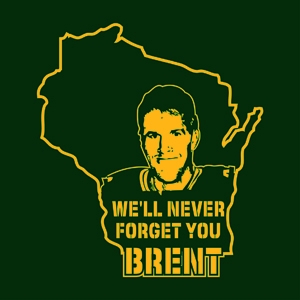
1. Brett Favre is not happy about this and will unretire to prove it. A commemorative decoration (ht Maize 'n Brew, via sconnie.com):

2. How science can save you from choking. This new bit from Jonah Lehrer is a nice complement to my earlier post on football decision making and the brain.
3. "SEC offers great drama, even football." The Big 10 media day, however, does not live up to its frat-guy, party school reputation. (And this gets a link solely because of the Dr. Octagon reference.)
4. Can NCAA athletes be denied access to agents? I don't have a ready answer to this question, though read up about it here. (Ht Dr Saturday.)
5. Monte Kiffin would like to remind you again that he will outwork you. You know, just in case you forgot.
6. An inviting summary:
7. Back when I wrote this, I got a fair bit of heat and disagreement:
Well, it appears to finally be sinking in. The NY Times reports:
Again, remember that this gun possession charge Burress was hit with has a two-years mandatory minimum. Sure, he can plead for less, but this doesn't seem a particularly difficult charge to prove: he brought the gun into the club and shot himself. That makes this next bit a bit strange to me.
Again, not sure what a not guilty plea would get Plax.
2. How science can save you from choking. This new bit from Jonah Lehrer is a nice complement to my earlier post on football decision making and the brain.
Kenny Perry could taste history. He had a two-shot lead with two holes to go at the 2009 Masters - all he had to do was not make any big mistakes and he would become, at 48, the oldest Masters champion in history. For three days at Augusta, he had played the best golf of his life: on the first 70 holes, he made only four bogeys. But then, at the 71st hole, everything started to fall apart. . . .
We call such failures "choking", if only because a person frayed by pressure might as well not have oxygen. What makes choking so morbidly fascinating is that the performers are incapacitated by their own thoughts. Perry, for example, was so worried about not making a mistake on the 17th that he played a disastrous chip. His mind sabotaged itself.
Scientists have begun to uncover the causes of choking, diagnosing the particular mental differences that allow some people to succeed while others wither in the spotlight. Although it might seem like an amorphous category of failure, their work has revealed that choking is triggered by a specific mental mistake: thinking too much.
The sequence of events typically goes like this: when people get nervous about performing, they become self-conscious. They start to fixate on themselves, trying to make sure that they don't make any mistakes. This can be lethal for a performer. The bowler concentrates too much on his action and loses control of the ball. The footballer misses the penalty by a mile. In each instance, the natural fluidity of performance is lost; the grace of talent disappears.
Sian Beilock, a professor of psychology at the University of Chicago, has helped illuminate the anatomy of choking. She uses golf as her experimental paradigm. When people are learning how to putt, it can seem daunting. There are just so many things to think about. Golfers need to assess the lay of the green, calculate the line of the ball, and get a feel for the grain of the turf. Then they have to monitor their putting motion and make sure that they hit the ball with a smooth, straight stroke. For an inexperienced player, a golf putt can seem unbearably hard, like a life-sized trigonometry problem.
But the mental exertion pays off, at least at first. Beilock has shown that novices hit better putts when they consciously reflect on their actions. The more time they spend thinking about the putt, the more likely they are to hole the ball. By concentrating on their game, by paying attention to the mechanics of their stroke, they can avoid beginner's mistakes.
A little experience, however, changes everything.
3. "SEC offers great drama, even football." The Big 10 media day, however, does not live up to its frat-guy, party school reputation. (And this gets a link solely because of the Dr. Octagon reference.)
4. Can NCAA athletes be denied access to agents? I don't have a ready answer to this question, though read up about it here. (Ht Dr Saturday.)
5. Monte Kiffin would like to remind you again that he will outwork you. You know, just in case you forgot.
6. An inviting summary:
With the ESPN cameras gone and prize money drying up, the glory years of the Lumberjack world championships appear to be long over.
7. Back when I wrote this, I got a fair bit of heat and disagreement:
Hello! Plaxico Burress is going to jail. . . . [T]he NFL community -- and not just fans -- seem rather blind to the reality that Plaxico faces gun charges with a mandatory minimum sentence and the prosecutors do not appear interested in granting him grace, and so he is going to serve some real jail time. Who he signs with is rather beside the point.
Well, it appears to finally be sinking in. The NY Times reports:
Manhattan's district attorney says he wants former Giants wide receiver Plaxico Burress to serve time in prison, the New York Post reported. Robert Morgenthau told the newspaper that Burress, who shot himself with an unlicensed gun in November, was willing to agree to spend a year in jail, but prosecutors insisted on two.
''We've always taken the position that he's going to have to go to jail, whether by trial or by plea,'' Morgenthau told the Post for a story in Monday's edition.
Again, remember that this gun possession charge Burress was hit with has a two-years mandatory minimum. Sure, he can plead for less, but this doesn't seem a particularly difficult charge to prove: he brought the gun into the club and shot himself. That makes this next bit a bit strange to me.
Brafman [Plaxico's lawyer] had previously said he no longer thought the matter would be resolved through a plea agreement and that prosecutors would take the case to a grand jury. He also said Burress would plead not guilty if the case went to trial.
Again, not sure what a not guilty plea would get Plax.
Smart Links and Notes 7/27/09
1. ESPN's Bruce Feldman asks a panel "What makes a great college coach?" (Insider required.)
That's my answer. Other contributors Feldman asked included former GA coach Jim Donnan, Rod Gilmore of ESPN, Jim Hofher Delaware's OC, and Phil Steele ("My No. 1 judge of a coach is how often they outperform my magazine's expectations."), among others.
2. Brophy chimes in with more on the "robber" coverage, as a jump-off from my recent bit on Va Tech's D for Dr Saturday. He includes some classic coaching tape of Virginia Tech vs. Syracuse in 1998 (McNabb was QB for the Orangemen).
3. The Blue-Gray Sky breaks down -- and is down on -- Notre Dame's use of the draw play. They do a nice job, but I'm confused why they are so down on the draw play. Michael points out that the play's average in 2008 was 4.9, which was down from a high of 5.3 yards per carry in 2005. That's true that it was down, but that's still a pretty good average for a team that averaged a paltry 3.27 yards per carry. (And if you take Jimmy Clausen's 54 "carries" for -74 yards out of the equation, ND still only averaged 3.92 YPC.)
Notre Dame's problems with the rush appear to be two-fold: one, they just need to get better at blocking up front, and maybe BGS is right that just committing to the inside zone or some other play will make them better; and second, the pass game is not as dangerous as it was, as in 2005 Brady Quinn averaged an impressive 8.7 yards per pass attempt (unadjusted). If I were them I would focus on a simpler base of run plays: four or five at the max. Anyway, check out the original post.
4. I agree with the Senator: The Tebow-gate vote scandal was anti-climactic (Spurrier: Uh, I didn't care enough to do it myself and someone else either got cute or lazy and I never looked. In fact, I never look.) As I take the Senator's point to be, do we care if coaches don't really bother with these things? I sure don't. I always figured the "Coaches poll" -- in its various forms -- basically just stood for "someone over there at the coaches office and/or athletic department of that school," and that was good enough for me. It's more of an issue of who else you'd want to ask.
5. File this in the category of strange ideas: Zach Zaremba wants Southern Cal to switch to the spread offense.
Uh. There's more there, but the argument seems to be that USC isn't scoring as many points as, say, Oklahoma or Florida, and they haven't won a National Title in four years. But that doesn't make much sense: USC lost to Oregon State last year, in a single defensive breakdown, and Stanford the year before, in just a fluke game (many spread offenses have had similar breakdown games). Relatedly, this really can't be an issue of being wide open enough, as USC throws the ball plenty and does -- contrary to what the article says -- use four and five receiver sets (though not with the frequency of a team like Florida).
The other reason of course that USC hasn't won a title game over the last four seasons (aside from facing Vince Young), is that the Pac-10 has let USC down: Florida, which won two of the last three titles, had a loss each season, and LSU lost two games. It's a strength of schedule thing.
Anyway I'm getting off topic. The article is weird, and based on an equally weird premise: "The spread offense is the most popular offense in football today." That, to me, is a good reason not to run the spread. Look, the issue with pro-style offenses versus spread offenses is that spread offenses, where the quarterback is a dynamic runner, can get an arithmetic advantage. But that doesn't make dropback passing obsolete; if your guy is Peyton Manning or Tom Brady -- or the college equivalent, like Leinert or Carson Palmer were -- then you are more than dynamic enough. It's not easy to find guys with that kind of passing ability, but USC definitely can.
"He must be able to develop players. Good X's and O's can only put players in a position to succeed; they must also be taught the tools to actually do so. This requires that the coach be a great teacher of technique, drive, and desire (and if he is head coach he must be able to teach his players and his coaches those things as well), and to be a great teacher the players must also know that he cares before they will listen. Styles may differ -- compare Pete Carroll to Bear Bryant -- but the players must be willing to run through a wall for their coach."
That's my answer. Other contributors Feldman asked included former GA coach Jim Donnan, Rod Gilmore of ESPN, Jim Hofher Delaware's OC, and Phil Steele ("My No. 1 judge of a coach is how often they outperform my magazine's expectations."), among others.
2. Brophy chimes in with more on the "robber" coverage, as a jump-off from my recent bit on Va Tech's D for Dr Saturday. He includes some classic coaching tape of Virginia Tech vs. Syracuse in 1998 (McNabb was QB for the Orangemen).
3. The Blue-Gray Sky breaks down -- and is down on -- Notre Dame's use of the draw play. They do a nice job, but I'm confused why they are so down on the draw play. Michael points out that the play's average in 2008 was 4.9, which was down from a high of 5.3 yards per carry in 2005. That's true that it was down, but that's still a pretty good average for a team that averaged a paltry 3.27 yards per carry. (And if you take Jimmy Clausen's 54 "carries" for -74 yards out of the equation, ND still only averaged 3.92 YPC.)
Notre Dame's problems with the rush appear to be two-fold: one, they just need to get better at blocking up front, and maybe BGS is right that just committing to the inside zone or some other play will make them better; and second, the pass game is not as dangerous as it was, as in 2005 Brady Quinn averaged an impressive 8.7 yards per pass attempt (unadjusted). If I were them I would focus on a simpler base of run plays: four or five at the max. Anyway, check out the original post.
4. I agree with the Senator: The Tebow-gate vote scandal was anti-climactic (Spurrier: Uh, I didn't care enough to do it myself and someone else either got cute or lazy and I never looked. In fact, I never look.) As I take the Senator's point to be, do we care if coaches don't really bother with these things? I sure don't. I always figured the "Coaches poll" -- in its various forms -- basically just stood for "someone over there at the coaches office and/or athletic department of that school," and that was good enough for me. It's more of an issue of who else you'd want to ask.
5. File this in the category of strange ideas: Zach Zaremba wants Southern Cal to switch to the spread offense.
The Trojans have the athletes to run this prolific offense, so will they get behind the eight ball, or follow suit as so many teams have already done and install the offense of the 21st century?
Powerhouses such as Texas, Oklahoma, Ohio State, Michigan, Virginia Tech, Penn State, Florida and West Virginia have made the switch. When will the mighty Trojans?
Uh. There's more there, but the argument seems to be that USC isn't scoring as many points as, say, Oklahoma or Florida, and they haven't won a National Title in four years. But that doesn't make much sense: USC lost to Oregon State last year, in a single defensive breakdown, and Stanford the year before, in just a fluke game (many spread offenses have had similar breakdown games). Relatedly, this really can't be an issue of being wide open enough, as USC throws the ball plenty and does -- contrary to what the article says -- use four and five receiver sets (though not with the frequency of a team like Florida).
The other reason of course that USC hasn't won a title game over the last four seasons (aside from facing Vince Young), is that the Pac-10 has let USC down: Florida, which won two of the last three titles, had a loss each season, and LSU lost two games. It's a strength of schedule thing.
Anyway I'm getting off topic. The article is weird, and based on an equally weird premise: "The spread offense is the most popular offense in football today." That, to me, is a good reason not to run the spread. Look, the issue with pro-style offenses versus spread offenses is that spread offenses, where the quarterback is a dynamic runner, can get an arithmetic advantage. But that doesn't make dropback passing obsolete; if your guy is Peyton Manning or Tom Brady -- or the college equivalent, like Leinert or Carson Palmer were -- then you are more than dynamic enough. It's not easy to find guys with that kind of passing ability, but USC definitely can.
Subscribe to:
Posts (Atom)


