Showing posts with label blog buds. Show all posts

Smart Notes and Links 8/13/2009

1. Advanced NFL Stats weighs in on the evaluating running backs/running games discussion, which I addressed (with assistance from some wonderful comments) here and here. Do read the whole thing, but Brian has, as always, a very interesting take. Drawing on earlier discussion about risky and conservative strategies for underdogs and favorites (see my discussion of the topic here and Brian's here), he asserts:

I want to address an age-old water cooler question that Chris discussed in his post at Smart Football. Consider two RBs, both with identical YPC averages. One however, is a boom and bust guy, like Barry Sanders, and the other is a steady plodder like Jerome Bettis. Which kind of RB would you rather have on your team?

The answer is it depends. Essentially, we have a choice between a high-variance RB and a low-variance RB. When a team is an underdog team, it wants high-variance intermediate outcomes to maximize its chances of winning. And when a team is a favorite, it wants low-variance outcomes. Whether those outcomes occur through play selection, through 4th down doctrine, or through RB style, isn't important. If you're an otherwise below-average team, you'd want the boom and bust style RB. If you're an otherwise above-average team, you'd want the steady plodder. . . .

Further, even if the high-variance RB has a lower average YPC, we'd still want him carrying the ball when we're losing. This is due to the math involved in competing probability distributions.


That's just one aspect of it. He uses a handy chart for the distribution of runs for the various backs...
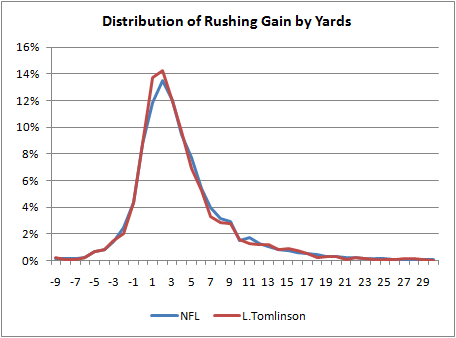


...and notes how curious it is that Tomlinson's distribution looks so much like that of the rest of the NFL. (This same thing ends up holding true for most backs.) What conclusions does Burke draw? With the usual caveats,

[w]hat amazes me is how similar they all are to each other and to the league average. . . . Usually, a RB needs 4 to 5 yards to just break even in terms of his team's probability of converting a first down. What we'd want to see on a RB's distribution is as much probability mass as possible to the right of 4 yards.

So if [Jerome] Bettis' distribution looks so much like Tomlinson's, how does Bettis have a 3.9 career YPC and Tomlinson have a 4.4 career YPC? As others have noted previously, the difference among RB YPC numbers primarily come from big runs. It's the open field breakaway ability that separates the guys with big YPC stats from the other RBs. Of Tomlinson's runs, 1.5% were for 30 yards or more. Bettis' 30+ yd gains comprised only 0.46% of his carries. The other RBs and the league average are as follows:

- NFL 0.91%
- [Jamal] Lewis 0.88%
- [Brian] Westbrook 0.93%
- [Adrian] Peterson 2.20%

Adrian Peterson's 2.2% figure is exceptional. It's interesting because it really suggests that what separates Peterson as a great runner is based on only 2% or so of his runs. Otherwise, he's practically average.


2. Courtesy of Brophy, I have added video of Mike Leach's "settle & noose" drill, which, it will be recalled, is both a great warm-up drill and works on teaching receivers to find holes in the zone and quarterbacks how to deliver the ball to them.


3. Tom Brady muses on life with Bill Belichick. As he tells Details:

"You'll practice on a Wednesday, and you'll come in Thursday morning and he'll have the film up there from practice," Brady says. "Sometimes, during practice, you throw a bad ball—that's the way it goes. But the video comes up and he says, 'Brady, you can't complete a g--damn hitch.' And I'll be sitting there thinking, I'm a [expletive] nine-year veteran, I've won three ---damn Super Bowls — he can kiss my... That's what you're thinking on the inside. But on the outside I'm thinking, You know what? I'm glad he's saying that. I'm glad that's what he's expecting, you know? Because that's what I should be expecting. That's what his style is."


(Ht Shutdown Corner).

4. Bruce Feldman chats with Norm Chow, who materializes into matter from various spectral rays to participate.

5. The NY Times's The Quad Blog chats with Dan Shanoff about, what else, his Tim Teblow blog.

6. Spencer Hall/Orson Swindle to SB Nation. When you get $7 million from Comcast, you better find ways to spend it, and I can't think of a better way than for SBNation (whose official name is "Sportsblogs, Inc.") to lure Every Day Should Be Saturday's Spencer Hall over, including away from the Sporting News. I like everyone else think this is a wise move for both sides, but one underrated aspect is that Mr. Hall/Swindle (Mr. Hall-Swindle? I kind of like that) will be able to focus on just one blog (and probably a book too), which should really let him flourish.

7. Holly over at Dr Saturday remembers Northwestern's magical 1995 season, which is still the only 10 win season in school history. This was a sort of epoch-changing season for NW -- though that is a very relative statement -- in that the Wildcats' history since has been considerably better. Indeed, two years later I saw them play in the Citrus Bowl against Tennessee (this was back in the "You can't spell Citrus without UT" days). Though, most of that game was spent marveling at the show Peyton Manning put on (408 yards, 4 touchdowns, no interceptions) as I sat there telling everyone around me what Peyton Manning's audibles would be (for some reason Northwestern thought it could play man coverage against Tennessee's receivers, so he kept checking to fades and slants). In any event, it is hard to overstate how strange but wonderful that 1995 season was for Northwestern. In football, sometimes the gods are with you.

Assorted Links - 8/10/2009

1. Michigan cast off Justin Feagin was involved in some wild stuff. Mgoblog comments:

Freep FOIA findings:

Feagin told investigators that “when I first started going to (Burke’s) house he had three big jars of weed up in his room. … One day T.J. was talking to me about some illegal stuff. He was under a lot of pressure because of his financial problems.

“I told him that I knew someone who could get him some cocaine. A few days later he asked me if I had talked to the person yet. I called right then and set up a deal.”

Feagin arranged to send $600 to a friend in Florida, whom he identified only as “Tragic.” In exchange, “Tragic” would send an ounce of cocaine to Ann Arbor.

It goes on from there. No cocaine ever showed up, this Burke guy tried to scare/murder Feagin by filling a bottle with gasoline and setting it on fire outside his dorm room, etc, etc, etc. You know, typical college stuff. . . . TJ Burke does what he wants, which is apparently spend up to ten years in prison.

Feagin was a last-minute addition to Michigan's first class under Rodriguez when it became clear that Rodriguez wasn't likely to acquire a higher-rated quarterback recruit. He did not work out, obviously. The Freep article dryly notes that Feagin "struggled to learn the playbook" mere paragraphs after describing Feagin's extensive marijuana habit. . . .

But seriously: it's bad. It's also one guy that Michigan apparently didn't run as thorough of a background check on—or possibly any background check on—as they scrambled to reconfigure Rodriguez's first recruiting class. As long as the incident remains isolated, fine. . . .


2. Mark Sanchez might win the Jets' job, but is he crossing over from confident to arrogant?

3. The NY Times Fifth Down Blog remembers Eagles defensive coordinator Jim Johnson (and includes your humble blogger in its roundup).

4. The pro-football reference blog with Part III of its quest to rank the greatest QBs of all time.

5. Steve Spurrier is very upset: "We've got a lot of guys, I don't even know if they like football." (Ht Blutarsky.)

6. Saurian Sagacity looks at statistical characteristics of BCS champions. This is good and fine, but as Dr Saturday pointed out, the BCS winner hasn't always been the "best" team over time, or even in a given year. This is not a BCS knock -- and on this score I don't think a playoff would reduce the randomness of who gets crowned champion -- but it's worth remembering.

6. The end of the postal service?

7. Callers, tossers, and the odds of the flip.

8. History of the Times New Roman typeface.

Assorted Links

1. Video of Notre Dame coach Frank Verducci coaching up the line. (H/t Blue Gray Sky)

2. Blue Gray Sky then explores the "sprint" or "stretch" run play.

3. Pro Football Reference blog compares AFL and NFL drafts.

4. New Detroit Lions' coach Jim Schwartz refuses to read books written by women. I recommend Margaret Atwood.

5. Creative types flocking to the internet, where fame can be instant but fleeting.

Breaking down the Oklahoma State offense

...over at Dr Saturday. Check it out here, and feel free to ask questions either here or over there. (I am more likely to see it here, though.)

Smart Links 7/30/09

1. T. Kyle King has an interesting response to my incoherent musings on business and life in college football.

2. Dan Shanoff really doesn't believe Brett Favre.

3. Blutarsky is bringing the Mummepoll back. Get ready.

4. Steve Kragthorpe is determined to purge the University of Louisville of all things Brohm.

5. Captain Leach doesn't twitter, and reiterates his support for a 64-team college football playoff. I will say this: there would be some wild football, with every game a do-or-die. Some frantic, last minute wildness, every week. It might be infeasible, but the more I hear this idea the more I think it does sound fun.

6. Best thing you'll see in awhile.

7. USC's use of coaching consultants is questioned.

8. Finally, I'll be traveling today, but check out Dr Saturday as I should have a post up there later this afternoon, fitting in with the Doc's Big 12 week.

Smart Notes and Links 7/28/09

1. Brett Favre is not happy about this and will unretire to prove it. A commemorative decoration (ht Maize 'n Brew, via sconnie.com):


2. How science can save you from choking. This new bit from Jonah Lehrer is a nice complement to my earlier post on football decision making and the brain.

Kenny Perry could taste history. He had a two-shot lead with two holes to go at the 2009 Masters - all he had to do was not make any big mistakes and he would become, at 48, the oldest Masters champion in history. For three days at Augusta, he had played the best golf of his life: on the first 70 holes, he made only four bogeys. But then, at the 71st hole, everything started to fall apart. . . .

We call such failures "choking", if only because a person frayed by pressure might as well not have oxygen. What makes choking so morbidly fascinating is that the performers are incapacitated by their own thoughts. Perry, for example, was so worried about not making a mistake on the 17th that he played a disastrous chip. His mind sabotaged itself.

Scientists have begun to uncover the causes of choking, diagnosing the particular mental differences that allow some people to succeed while others wither in the spotlight. Although it might seem like an amorphous category of failure, their work has revealed that choking is triggered by a specific mental mistake: thinking too much.

The sequence of events typically goes like this: when people get nervous about performing, they become self-conscious. They start to fixate on themselves, trying to make sure that they don't make any mistakes. This can be lethal for a performer. The bowler concentrates too much on his action and loses control of the ball. The footballer misses the penalty by a mile. In each instance, the natural fluidity of performance is lost; the grace of talent disappears.

Sian Beilock, a professor of psychology at the University of Chicago, has helped illuminate the anatomy of choking. She uses golf as her experimental paradigm. When people are learning how to putt, it can seem daunting. There are just so many things to think about. Golfers need to assess the lay of the green, calculate the line of the ball, and get a feel for the grain of the turf. Then they have to monitor their putting motion and make sure that they hit the ball with a smooth, straight stroke. For an inexperienced player, a golf putt can seem unbearably hard, like a life-sized trigonometry problem.

But the mental exertion pays off, at least at first. Beilock has shown that novices hit better putts when they consciously reflect on their actions. The more time they spend thinking about the putt, the more likely they are to hole the ball. By concentrating on their game, by paying attention to the mechanics of their stroke, they can avoid beginner's mistakes.

A little experience, however, changes everything.


3. "SEC offers great drama, even football." The Big 10 media day, however, does not live up to its frat-guy, party school reputation. (And this gets a link solely because of the Dr. Octagon reference.)

4. Can NCAA athletes be denied access to agents? I don't have a ready answer to this question, though read up about it here. (Ht Dr Saturday.)

5. Monte Kiffin would like to remind you again that he will outwork you. You know, just in case you forgot.

6. An inviting summary:

With the ESPN cameras gone and prize money drying up, the glory years of the Lumberjack world championships appear to be long over.


7. Back when I wrote this, I got a fair bit of heat and disagreement:

Hello! Plaxico Burress is going to jail. . . . [T]he NFL community -- and not just fans -- seem rather blind to the reality that Plaxico faces gun charges with a mandatory minimum sentence and the prosecutors do not appear interested in granting him grace, and so he is going to serve some real jail time. Who he signs with is rather beside the point.


Well, it appears to finally be sinking in. The NY Times reports:

Manhattan's district attorney says he wants former Giants wide receiver Plaxico Burress to serve time in prison, the New York Post reported. Robert Morgenthau told the newspaper that Burress, who shot himself with an unlicensed gun in November, was willing to agree to spend a year in jail, but prosecutors insisted on two.

''We've always taken the position that he's going to have to go to jail, whether by trial or by plea,'' Morgenthau told the Post for a story in Monday's edition.


Again, remember that this gun possession charge Burress was hit with has a two-years mandatory minimum. Sure, he can plead for less, but this doesn't seem a particularly difficult charge to prove: he brought the gun into the club and shot himself. That makes this next bit a bit strange to me.

Brafman [Plaxico's lawyer] had previously said he no longer thought the matter would be resolved through a plea agreement and that prosecutors would take the case to a grand jury. He also said Burress would plead not guilty if the case went to trial.


Again, not sure what a not guilty plea would get Plax.

Smart Links and Notes 7/27/09

1. ESPN's Bruce Feldman asks a panel "What makes a great college coach?" (Insider required.)

"He must be able to develop players. Good X's and O's can only put players in a position to succeed; they must also be taught the tools to actually do so. This requires that the coach be a great teacher of technique, drive, and desire (and if he is head coach he must be able to teach his players and his coaches those things as well), and to be a great teacher the players must also know that he cares before they will listen. Styles may differ -- compare Pete Carroll to Bear Bryant -- but the players must be willing to run through a wall for their coach."

That's my answer. Other contributors Feldman asked included former GA coach Jim Donnan, Rod Gilmore of ESPN, Jim Hofher Delaware's OC, and Phil Steele ("My No. 1 judge of a coach is how often they outperform my magazine's expectations."), among others.

2. Brophy chimes in with more on the "robber" coverage, as a jump-off from my recent bit on Va Tech's D for Dr Saturday. He includes some classic coaching tape of Virginia Tech vs. Syracuse in 1998 (McNabb was QB for the Orangemen).


3. The Blue-Gray Sky breaks down -- and is down on -- Notre Dame's use of the draw play. They do a nice job, but I'm confused why they are so down on the draw play. Michael points out that the play's average in 2008 was 4.9, which was down from a high of 5.3 yards per carry in 2005. That's true that it was down, but that's still a pretty good average for a team that averaged a paltry 3.27 yards per carry. (And if you take Jimmy Clausen's 54 "carries" for -74 yards out of the equation, ND still only averaged 3.92 YPC.)

Notre Dame's problems with the rush appear to be two-fold: one, they just need to get better at blocking up front, and maybe BGS is right that just committing to the inside zone or some other play will make them better; and second, the pass game is not as dangerous as it was, as in 2005 Brady Quinn averaged an impressive 8.7 yards per pass attempt (unadjusted). If I were them I would focus on a simpler base of run plays: four or five at the max. Anyway, check out the original post.

4. I agree with the Senator: The Tebow-gate vote scandal was anti-climactic (Spurrier: Uh, I didn't care enough to do it myself and someone else either got cute or lazy and I never looked. In fact, I never look.) As I take the Senator's point to be, do we care if coaches don't really bother with these things? I sure don't. I always figured the "Coaches poll" -- in its various forms -- basically just stood for "someone over there at the coaches office and/or athletic department of that school," and that was good enough for me. It's more of an issue of who else you'd want to ask.

5. File this in the category of strange ideas: Zach Zaremba wants Southern Cal to switch to the spread offense.
The Trojans have the athletes to run this prolific offense, so will they get behind the eight ball, or follow suit as so many teams have already done and install the offense of the 21st century?

Powerhouses such as Texas, Oklahoma, Ohio State, Michigan, Virginia Tech, Penn State, Florida and West Virginia have made the switch. When will the mighty Trojans?


Uh. There's more there, but the argument seems to be that USC isn't scoring as many points as, say, Oklahoma or Florida, and they haven't won a National Title in four years. But that doesn't make much sense: USC lost to Oregon State last year, in a single defensive breakdown, and Stanford the year before, in just a fluke game (many spread offenses have had similar breakdown games). Relatedly, this really can't be an issue of being wide open enough, as USC throws the ball plenty and does -- contrary to what the article says -- use four and five receiver sets (though not with the frequency of a team like Florida).

The other reason of course that USC hasn't won a title game over the last four seasons (aside from facing Vince Young), is that the Pac-10 has let USC down: Florida, which won two of the last three titles, had a loss each season, and LSU lost two games. It's a strength of schedule thing.

Anyway I'm getting off topic. The article is weird, and based on an equally weird premise: "The spread offense is the most popular offense in football today." That, to me, is a good reason not to run the spread. Look, the issue with pro-style offenses versus spread offenses is that spread offenses, where the quarterback is a dynamic runner, can get an arithmetic advantage. But that doesn't make dropback passing obsolete; if your guy is Peyton Manning or Tom Brady -- or the college equivalent, like Leinert or Carson Palmer were -- then you are more than dynamic enough. It's not easy to find guys with that kind of passing ability, but USC definitely can.