Showing posts with label airraid. Show all posts

Smart Notes and Links 8/13/2009

1. Advanced NFL Stats weighs in on the evaluating running backs/running games discussion, which I addressed (with assistance from some wonderful comments) here and here. Do read the whole thing, but Brian has, as always, a very interesting take. Drawing on earlier discussion about risky and conservative strategies for underdogs and favorites (see my discussion of the topic here and Brian's here), he asserts:

I want to address an age-old water cooler question that Chris discussed in his post at Smart Football. Consider two RBs, both with identical YPC averages. One however, is a boom and bust guy, like Barry Sanders, and the other is a steady plodder like Jerome Bettis. Which kind of RB would you rather have on your team?

The answer is it depends. Essentially, we have a choice between a high-variance RB and a low-variance RB. When a team is an underdog team, it wants high-variance intermediate outcomes to maximize its chances of winning. And when a team is a favorite, it wants low-variance outcomes. Whether those outcomes occur through play selection, through 4th down doctrine, or through RB style, isn't important. If you're an otherwise below-average team, you'd want the boom and bust style RB. If you're an otherwise above-average team, you'd want the steady plodder. . . .

Further, even if the high-variance RB has a lower average YPC, we'd still want him carrying the ball when we're losing. This is due to the math involved in competing probability distributions.


That's just one aspect of it. He uses a handy chart for the distribution of runs for the various backs...
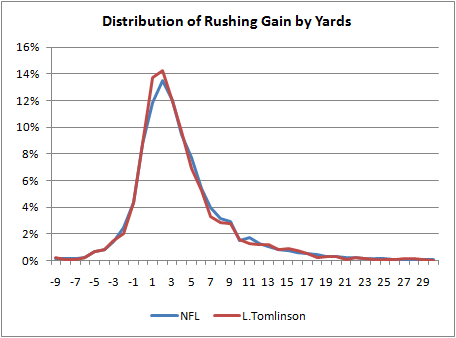


...and notes how curious it is that Tomlinson's distribution looks so much like that of the rest of the NFL. (This same thing ends up holding true for most backs.) What conclusions does Burke draw? With the usual caveats,

[w]hat amazes me is how similar they all are to each other and to the league average. . . . Usually, a RB needs 4 to 5 yards to just break even in terms of his team's probability of converting a first down. What we'd want to see on a RB's distribution is as much probability mass as possible to the right of 4 yards.

So if [Jerome] Bettis' distribution looks so much like Tomlinson's, how does Bettis have a 3.9 career YPC and Tomlinson have a 4.4 career YPC? As others have noted previously, the difference among RB YPC numbers primarily come from big runs. It's the open field breakaway ability that separates the guys with big YPC stats from the other RBs. Of Tomlinson's runs, 1.5% were for 30 yards or more. Bettis' 30+ yd gains comprised only 0.46% of his carries. The other RBs and the league average are as follows:

- NFL 0.91%
- [Jamal] Lewis 0.88%
- [Brian] Westbrook 0.93%
- [Adrian] Peterson 2.20%

Adrian Peterson's 2.2% figure is exceptional. It's interesting because it really suggests that what separates Peterson as a great runner is based on only 2% or so of his runs. Otherwise, he's practically average.


2. Courtesy of Brophy, I have added video of Mike Leach's "settle & noose" drill, which, it will be recalled, is both a great warm-up drill and works on teaching receivers to find holes in the zone and quarterbacks how to deliver the ball to them.


3. Tom Brady muses on life with Bill Belichick. As he tells Details:

"You'll practice on a Wednesday, and you'll come in Thursday morning and he'll have the film up there from practice," Brady says. "Sometimes, during practice, you throw a bad ball—that's the way it goes. But the video comes up and he says, 'Brady, you can't complete a g--damn hitch.' And I'll be sitting there thinking, I'm a [expletive] nine-year veteran, I've won three ---damn Super Bowls — he can kiss my... That's what you're thinking on the inside. But on the outside I'm thinking, You know what? I'm glad he's saying that. I'm glad that's what he's expecting, you know? Because that's what I should be expecting. That's what his style is."


(Ht Shutdown Corner).

4. Bruce Feldman chats with Norm Chow, who materializes into matter from various spectral rays to participate.

5. The NY Times's The Quad Blog chats with Dan Shanoff about, what else, his Tim Teblow blog.

6. Spencer Hall/Orson Swindle to SB Nation. When you get $7 million from Comcast, you better find ways to spend it, and I can't think of a better way than for SBNation (whose official name is "Sportsblogs, Inc.") to lure Every Day Should Be Saturday's Spencer Hall over, including away from the Sporting News. I like everyone else think this is a wise move for both sides, but one underrated aspect is that Mr. Hall/Swindle (Mr. Hall-Swindle? I kind of like that) will be able to focus on just one blog (and probably a book too), which should really let him flourish.

7. Holly over at Dr Saturday remembers Northwestern's magical 1995 season, which is still the only 10 win season in school history. This was a sort of epoch-changing season for NW -- though that is a very relative statement -- in that the Wildcats' history since has been considerably better. Indeed, two years later I saw them play in the Citrus Bowl against Tennessee (this was back in the "You can't spell Citrus without UT" days). Though, most of that game was spent marveling at the show Peyton Manning put on (408 yards, 4 touchdowns, no interceptions) as I sat there telling everyone around me what Peyton Manning's audibles would be (for some reason Northwestern thought it could play man coverage against Tennessee's receivers, so he kept checking to fades and slants). In any event, it is hard to overstate how strange but wonderful that 1995 season was for Northwestern. In football, sometimes the gods are with you.

How Mike Leach keeps producing prolific passers

Dr Saturday recently observed that

[o]f the five starters Leach has trotted out in nine years, every one has topped 4,000 yards and 30 touchdowns in a season; even in terms of efficiency as opposed to straight cumulative totals, they've been remarkably consistent from year to year.


He also notes that it's unlikely that Texas Tech will quite reach the heights they did last year, and that "[u]nless the stars align for the new kids in some unforeseen, improbably way, even 4,200 yards and 35 touchdowns could feel like the first hints of stagnation in the success story." Quite likely. But how has Leach continued to produce such wildly successful (in terms of stats, at least) quarterback?

One answer is "the system," but let's get more specific. The Captain has frequently noted that his system is all stuff that's been done before. Indeed, what is remarkable is that guys can seem to leap off the bench and do nothing but throw completions. He had one of the great three-year runs, where, defying the common spread/passing offense wisdom of playing your younger guy so they can get some experience, he rode three fifth-year senior quarterbacks to great heights (and, again, stats).

My explanation, and I think Leach would agree with me, is how the Red Raiders practice. One, they obviously do not run the ball much so all the focus is on throwing and catching, every day. Leach also does not believe in traditional stretching; rather he begins practices with medium speed drills that work on techniques like settling in the windows between zones and dropping back and throwing. Everything is focused on throwing the ball. Bob Davie visited Texas Tech a few years ago, and was blown away by what he saw:

Last year, Tech averaged 60 passes a game so it is obviously not a balanced attack, but this actually works in their favor. In practice, they spend virtually all their time focusing on fundamentals related to the passing game. From the time they hit the practice field until they leave, the ball is in the air and the emphasis in on throwing, catching and protecting the quarterback.

It takes great confidence in your scheme to be able to take this approach, but the players appreciate it because they can focus on execution.

Practice -- What's Different

When you watch Texas Tech practice, it doesn't seem as structured as most college practices. They do not stretch as a team and unlike most practices, there is not a horn blowing every five minutes to change drills. The bottom line is that the cosmetic appearance of practice is not as important to Leach as it is to some coaches.

Although not as structured, it is impressive to watch Texas Tech practice and you quickly see why it is so successful. The ball is always in the air and what the Red Raiders practice is what you see them do in a game. They work on every phase of their package every day and in most passing drills, there are four quarterbacks throwing and every eligible receiver catching on each snap.

There is great detail given to fundamentals in all phases of the passing game. Wide receivers, for example, work every day on releases versus different coverages, ball security, scrambling drills, blocking and routes versus specific coverages.


Davie is referencing some of the specific "Airraid" passing drills -- the real secret to the scheme's success. The main drills are:

  • Settle-noose: This is basically a warm-up drill. The receivers begin out quarter speed and shuffle between two cones, "settling" nearer to one than the other, as if they were two zone defenders. The quarterback takes a drop -- again, reduced speed -- and throws the ball, aiming for the receiver but away from the nearer "defender." The receiver uses good catching form and bursts upfield after making the catch. You can see how this simple drill sets up the entire theory of their offense, which relies on finding seams in the zones and quarterbacks throwing between defenders. Check out the video below, courtesy of Brophy:


  • Pat-n-go: This is another simple drill. Most teams use a form of "route lines," or quarterbacks dropping and receivers running routes on "air" -- i.e. with no defenders. The one clever insight here is that one group of QBs and receivers lines up on opposite from another. This way they can complete a pass, have the receiver burst as if scoring, and simply get in line on the opposite side of the field, rather than have to run back through. Just another way they get more repetitions.

  • Routes on air: Probably their best drill. The coaches line up garbage cans or bags or whathaveyou where defenders would drop for a zone. Then all five receivers and/or runningbacks line up, and they call a play. Five quarterbacks (or four and a manager, etc) each drop back and throw the ball to a receiver. Here's the deal: if you're the QB who should throw it to the first read, you drop back and throw it to him. If you are assigned to the third read, well you drop back, look at #1, then #2, then #3 and throw it to him. Same goes for #2, #4, and even #5. Moreover, every receiver who runs the route catches a ball and practices scoring. Then the quarterbacks rotate over -- i.e. if you threw it to #2 now you throw it to #3, etc -- and a new group of receivers steps in. This way quarterbacks absolutely learn all their reads and practice it every day (how many reps like this does the third or fourth string guy at another school get?), and they also practice throwing it to all their receivers. Each time they do this

  • 7-on-7 and man-to-man: These are what they sound like, and most do these drills. One-on-one or man-to-man involves the receivers going against press man in practice, while 7-on-7 is like a real scrimmage, minus the linemen.
Good drills, no? As the Airraid practice plan shows, they do these drills almost every day. As Davie summed up:
Tech gets an amazing amount of repetitions in practice and most importantly, it doesn't waste reps practicing things they don't do in a game.
Indeed, if you're third-string quarterback at Texas Tech, I can't imagine a program whose third-stringer gets more reps than you. Same goes for second-string, third-string, etc. Now, games are certainly different -- Tech's defense has never been confused with Texas's or Oklahoma's -- but these drills, coupled with their total commitment to throwing the ball, is a big factor in Leach's ability to churn out successful quarterbacks.